AI Business Automation in 2025: The Complete Guide for Companies Ready to Scale
Every business has them — the repetitive tasks that eat through hours, the manual processes that drain talented people, the bottlenecks that slow growth. Sending follow-up emails. Chasing invoices. Copying data between systems. Generating weekly reports. These are not strategic activities. They are operational friction. And in 2025, there is no reason to accept them.
AI business automation has moved well beyond the hype. It is being deployed today by companies of every size — from solo consultants to mid-market enterprises — to eliminate manual workload, accelerate response times, and build operational systems that run around the clock without a human in the loop. This guide explains exactly what it is, how it works, and which sectors are seeing the greatest returns.
For companies looking at business process automation, AI agents for business, workflow automation Cyprus, AI automation benefits, or intelligent automation 2025, the practical opportunity is the same: remove repetitive operational work and create systems that scale without adding unnecessary headcount.
What Is AI Business Automation?
AI business automation is the practice of using artificial intelligence, intelligent software agents, and workflow automation tools to perform business tasks that previously required human effort. Unlike traditional automation — which follows fixed, rule-based logic — AI-powered automation can understand context, make decisions, adapt to new inputs, and improve over time.
A modern AI automation system might:
- Read and categorise incoming emails and route them to the right person or system
- Qualify inbound sales leads by analysing behaviour, fit, and intent — before a human speaks to them
- Generate a client performance report by pulling data from five different platforms, writing the analysis, and emailing it — every Monday at 8am, automatically
- Answer customer questions on WhatsApp at 2am using your company's own knowledge base
- Process an invoice, extract the relevant data, and post it to your accounting system — in seconds
The defining characteristic of AI automation is that it handles complexity. It does not just move data from A to B. It reads, interprets, decides, and acts.
Why 2025 Is the Inflection Point for Business Automation
Three forces have converged to make 2025 the most important year yet for business automation adoption.
The cost of AI has collapsed. Large language models that cost thousands of dollars per month to run two years ago now cost a fraction of that. Businesses that previously could not justify the investment can now automate intelligently for a few hundred euros per month.
The tools have matured. Platforms like n8n, combined with APIs from OpenAI, Anthropic, and others, allow sophisticated multi-step automation workflows to be built and deployed in weeks rather than months. The barrier to entry has never been lower.
The competitive gap is widening. Companies that have adopted automation are processing more work with the same headcount, responding to clients faster, and reinvesting the saved hours into growth. Companies that have not are falling behind — not because they lack talent, but because they lack leverage.
The question for most businesses in 2025 is no longer whether to automate. It is what to automate first.
The Core Benefits of AI Business Automation
Regardless of industry or company size, businesses that implement AI automation consistently report the same cluster of benefits.
Drastic reduction in manual workload. The most immediate and measurable impact of automation is time saved. Tasks that previously took a team member two hours can be completed in seconds. That time is either reinvested into higher-value work or allows the business to handle more volume without hiring.
Faster response times and always-on availability. AI agents do not have office hours. A WhatsApp bot can respond to a customer inquiry at midnight. A lead qualification agent can engage a new prospect within 30 seconds of them submitting a form — before they have even had time to contact a competitor.
Reduced human error. Manual data entry, copy-pasting between systems, and repetitive administrative tasks are primary sources of costly errors. Automation eliminates the error surface entirely for tasks it handles.
Scalability without proportional headcount growth. A human team has a ceiling. An automated system can handle ten times the volume with no additional cost. This is the lever that allows businesses to scale revenue without scaling overhead at the same rate.
Valuable, actionable data. Automated systems log every action, decision, and outcome. Over time, this creates a rich data set that gives business owners genuine visibility into operations — rather than relying on estimates and manual reporting.
Which Industries Benefit Most from AI Business Automation — and How
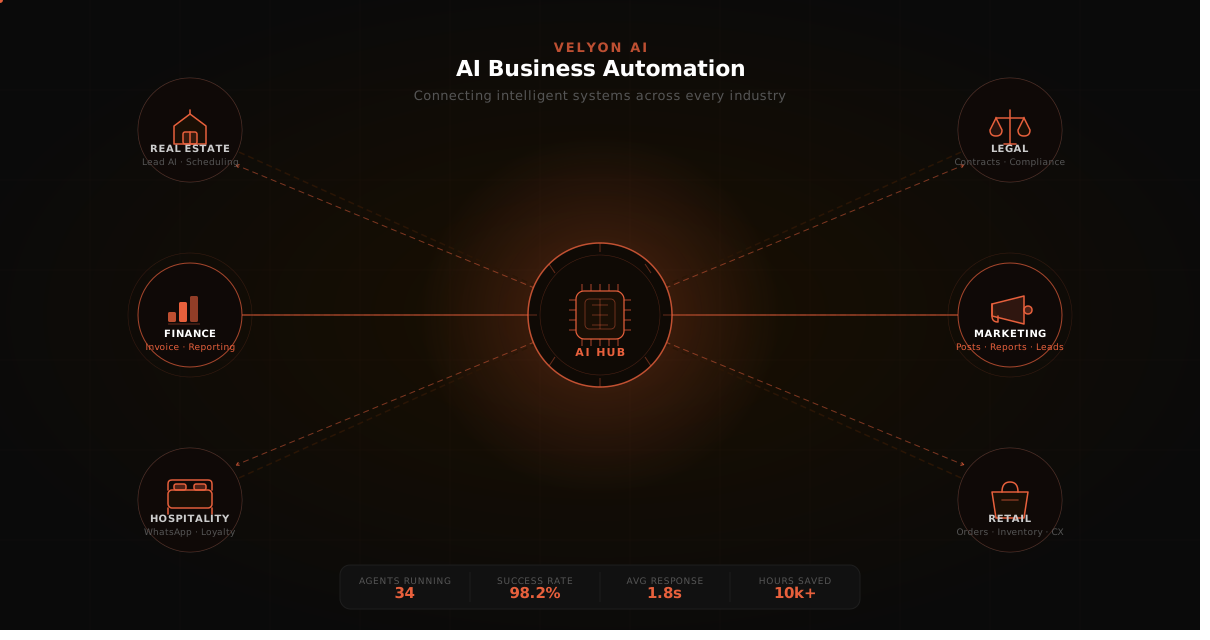
AI business automation is not sector-specific. It applies wherever there is repetitive work, data that moves between systems, or customer communication that follows predictable patterns. However, certain industries are seeing particularly transformative results.
Real Estate
Property agencies are drowning in lead volume, slow follow-up, and scheduling friction. AI automation addresses all three simultaneously. An intelligent lead qualification agent can engage every inbound inquiry within seconds, ask the right questions to identify genuine buyers, match them to relevant listings from a live database, and book viewings directly into the agent's calendar — without any human involvement until the viewing itself.
Post-viewing follow-ups, feedback requests, and valuation reminders can all be automated on a personalised schedule. Agencies using this approach report a 40% increase in viewing bookings and a dramatic reduction in leads lost to slow response times.
Finance, Accounting & Fintech
Finance teams are among the highest-value targets for automation because the tasks they perform manually — data entry, reconciliation, report generation, invoice processing — are highly structured and time-consuming. AI automation can extract data from invoices automatically, reconcile it against purchase orders, post it to accounting systems, and flag anomalies for human review.
Monthly and weekly financial reporting — traditionally a multi-hour task requiring data from multiple platforms — can be fully automated. An AI agent pulls the data, analyses variances, writes the commentary, and delivers the report to stakeholders on a fixed schedule. CFO-level insight, delivered automatically.
Hospitality & Tourism
Travel agencies, hotels, and tour operators interact with clients at multiple touchpoints before, during, and after a booking — each of which is an opportunity for a great experience or a missed one. AI automation ensures none of those touchpoints are missed.
Pre-trip WhatsApp reminders, personalised itinerary updates pulled from trip PDFs, post-trip review requests, and loyalty reward notifications can all be delivered automatically to each client at exactly the right moment. The result is a premium, highly personalised client experience that does not require a single additional staff member to maintain.
Legal & Compliance
Law firms and compliance departments are built on documents, deadlines, and detail — all of which are well-suited to automation. AI agents can draft initial contract versions from templates, review documents for standard clauses and risk flags, track compliance deadlines and send automated reminders, and monitor regulatory publications for updates relevant to the firm's practice areas.
The result is not AI replacing lawyers. It is lawyers spending their time on the work that requires genuine legal judgement, rather than on administrative tasks that do not.
Retail & E-Commerce
Order confirmations, shipping notifications, delivery follow-ups, review requests, inventory alerts, and weekly sales summaries — every one of these touchpoints in the e-commerce customer journey can be fully automated. More importantly, they can be personalised at scale.
AI-powered automation can segment customers by purchase behaviour and send tailored re-engagement campaigns, flag low-stock SKUs before they become stockouts, and surface weekly insights about which products, channels, and campaigns are driving the best margins — all without manual intervention.
Marketing & Social Media Agencies
Agencies are simultaneously under pressure to deliver more for clients while keeping their own operational costs under control. AI automation is the answer to both sides of that equation.
Content scheduling automation eliminates manual posting across multiple client accounts. Automated reporting systems pull performance data from social platforms, ad accounts, and analytics tools, generate branded PDF reports with AI-written commentary, and email them to clients on a fixed schedule. AI voice agents and WhatsApp bots handle inbound inquiries and booking requests around the clock. The result is an agency that appears to operate at a scale far beyond its actual headcount.
Healthcare & Medical Practices
Patient communication is one of the highest-friction areas in healthcare operations. Appointment reminders, follow-up messages, prescription renewal notifications, and post-consultation check-ins are all time-consuming for administrative staff and easy to miss. Automation handles all of them reliably, at scale, and with personalisation — freeing clinical and administrative teams to focus on patient care rather than logistics.
Professional Services & Consulting
Consultants, architects, engineers, and other professionals who sell their time and expertise lose a disproportionate amount of both to non-billable administrative work. Proposal generation, meeting scheduling, project status updates, invoice chasing, and client onboarding workflows can all be automated — giving professionals more billable hours and a more professional client experience without additional overhead.
How to Identify What to Automate First in Your Business
The best starting point for any automation programme is a structured review of where time is actually going in your business. Ask three questions:
What tasks does your team do more than once a week that follow a predictable pattern? Repetitive, structured tasks are the highest-return automation targets. If someone is doing the same thing every Monday, automation can do it instead.
Where are the delays that cost you money or client satisfaction? Slow lead response, late invoice follow-up, missed client communications — each of these has a measurable cost. Automation eliminates the delay entirely.
What reporting or data tasks require pulling information from multiple places? Any workflow that involves logging into three platforms, copying data into a spreadsheet, and emailing a summary is a strong automation candidate.
Once you have identified the highest-impact areas, you prioritise by a combination of frequency, time cost, and business impact — not by technical complexity. The most valuable automation is not always the most sophisticated one.
What Does an AI Business Automation Implementation Actually Look Like?
A well-run automation implementation follows a clear four-stage process.
Discovery. A structured workshop or series of calls to map your current workflows, identify pain points, and prioritise automation opportunities. The output is a prioritised automation roadmap.
Architecture & Development. The automation is designed, built, and tested in a staging environment. For most business automations, this takes between two and six weeks depending on complexity.
Deployment & Integration. The automation is connected to your live systems — your CRM, email, WhatsApp, databases, or wherever it needs to operate — and deployed to production.
Monitoring & Optimisation. Automations are not set-and-forget. Usage patterns emerge, edge cases appear, and AI models improve. Ongoing monitoring ensures the system continues to perform and improves over time.
A professional automation agency handles all four stages — and remains your technical partner for as long as the system is running.
Common Misconceptions About AI Business Automation
"Automation will replace my team." The reality is the opposite. Automation eliminates the tasks your team hates doing — the repetitive, manual, low-judgement work. It frees them to do more of the work that actually requires human intelligence, creativity, and relationship-building.
"It is only for large enterprises." The tools available today make sophisticated AI automation accessible to businesses with five employees just as much as those with five hundred. The economics work at every scale.
"It is too complex and expensive to implement." A well-scoped automation project can be delivered in weeks and pay for itself in months. The cost of inaction — the hours lost, the leads missed, the errors made — is almost always higher than the cost of automating.
"AI cannot be trusted to handle client communication." Modern AI agents, when properly trained on your business's knowledge base and tone of voice, produce communication that is accurate, professional, and personalised. They handle the predictable conversations; humans handle the complex ones.
Getting Started with AI Business Automation
The most important first step is not choosing a tool or writing a brief. It is having a conversation with someone who understands both the technology and your business context.
A 30-minute discovery call with an automation specialist is enough to identify two or three high-impact automation opportunities specific to your business, get a realistic sense of what implementation involves, and understand what the return on investment looks like in your specific situation.
The businesses seeing the greatest returns from AI automation in 2025 are not the ones that waited for the perfect moment. They are the ones that started with a single high-impact workflow, saw the results, and expanded from there.
The time to start is now.
At Velyon AI, we specialise in designing and deploying bespoke AI business automation systems for companies across Cyprus and the EU. Whether you are a travel agency, a law firm, an e-commerce brand, or a marketing agency, we will map your workflows, identify your highest-value automation opportunities, and build systems that run your operations more efficiently than you thought possible. Book a free discovery call today.
